Seeing the World Through Your Dog’s Eyes
Discover how dogs' unique vision affects their behavior. From blue-yellow color perception to motion detection and night vision—what every dog owner should know.

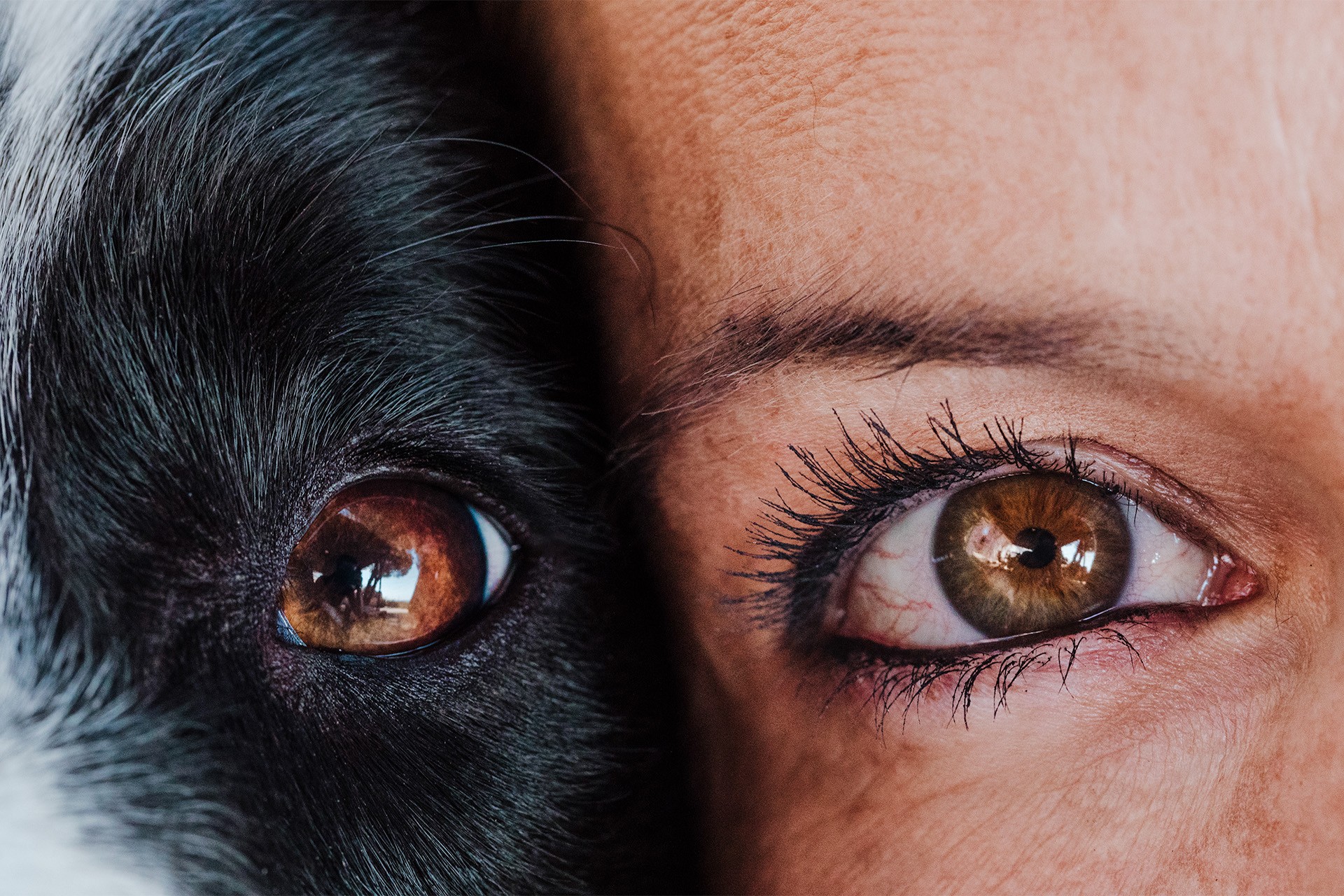
Dogs do not see the world the way humans do.
This isn’t just a fun fact. It has real implications for behavior, learning, confidence, and how dogs move through their environment.
A dog’s visual system is built for function, not detail. Compared to humans, dogs have more rods and fewer cones in their eyes.
Rods are responsible for detecting movement and working in low light.
Cones handle color and fine detail. This means dogs are especially sensitive to motion, but less sensitive to color and sharp visual clarity.
Dogs are dichromatic. Blue and yellow appear bright and clear.
Red and green tend to look dull, muddy, or greyish.
And dogs mostly have a 20/75 vision compared to the normal human vision of 20/20. In other words, they have to be 20 feet away to see something clearly as a human can see 75 feet away.

Left, what humans would see. Right, what dogs would see. (Based on a dog vision filter).
From our perspective, that can sound like a disadvantage. But vision isn’t about seeing more. It’s about seeing what matters for survival.
Motion, Contrast, and Meaning
Dogs rely heavily on contrast and movement to understand their environment.
For instance, a moving object will stand out quickly. Which is why they immediately react whenever they see a squirrel, when we don’t even notice it ourselves.
Strong contrast helps separate important information from background noise.
This also explains why visual clutter can overwhelm some dogs. Busy environments filled with movement, color variation, and visual noise demand constant processing. For a dog with a sensitive or over-aroused nervous system, that can lead to scanning, difficulty focusing, or reactivity.
Clear contrast, on the other hand, can support confidence and precision. This is why equipment color matters in visually guided sports like agility, and why simplifying the visual environment often helps dogs learn more easily.
What About Night Vision?
Dogs don’t have night vision in the way night vision goggles work. They aren’t seeing glowing outlines or bright images in complete darkness.
But they’re better equipped than humans to see in low-light conditions.
Dogs have more rods, a wider pupil, and a reflective layer behind the retina called the tapetum lucidum. This layer reflects light back through the retina, giving photoreceptors a second chance to capture it. It’s also what causes that familiar eye shine in the dark.
In bright daylight, humans have the advantage. We see sharper detail and a broader range of color.
At dusk, dawn, or in dim lighting, dogs often outperform us. Their visual system is optimized for those transitional light conditions where movement detection matters most.
Vision and Emotional State
Vision does not operate independently of emotion.
Visual information travels through the thalamus, a filtering station in the brain that decides how much sensory input reaches conscious processing. A dog’s emotional state influences that filter.
An anxious dog may visually scan constantly, taking in too much information without clear priorities. A calm, regulated dog can focus, orient, and stay connected to their human or task.
This is why emotional regulation plays such a powerful role in training. What a dog can see depends partly on how safe they feel while seeing it.
In some activities, we intentionally support visual engagement. In others, such as scent detection, reducing visual contrast can help dogs rely more fully on their nose instead of splitting attention between senses.
Try This With Your Dog This Week
1. Notice color, not just behavior
Pay attention to the colors of toys, bowls, or training equipment you use. Try offering a blue or yellow item and see if your dog engages with it more easily than red or green.
2. Reduce visual noise
During training or play, simplify the environment. Fewer objects, clearer spacing, and less movement can help your dog focus without needing to scan constantly.
3. Watch the eyes during arousal
When your dog is excited or stressed, notice how their eyes move. Rapid scanning often tells you more about their nervous system than their body posture does.
The Big Takeaway
Vision is not just about what dogs see.
It’s about how they feel while seeing it.
Understanding how dogs process visual information helps us design better environments, clearer learning experiences, and more compassionate expectations.
When we work with their sensory systems rather than against them, behavior becomes easier to understand and easier to support.